Identify the Regions and Landmarks of the Thoracic Cage
Identify the regions and landmarks of the thoracic cage. What is the general shape of the thoracic cage.

Gross I Thorax Region Bones Of The Thoracic Cage Flashcards Quizlet
Surface landmark for identifying rib 2.
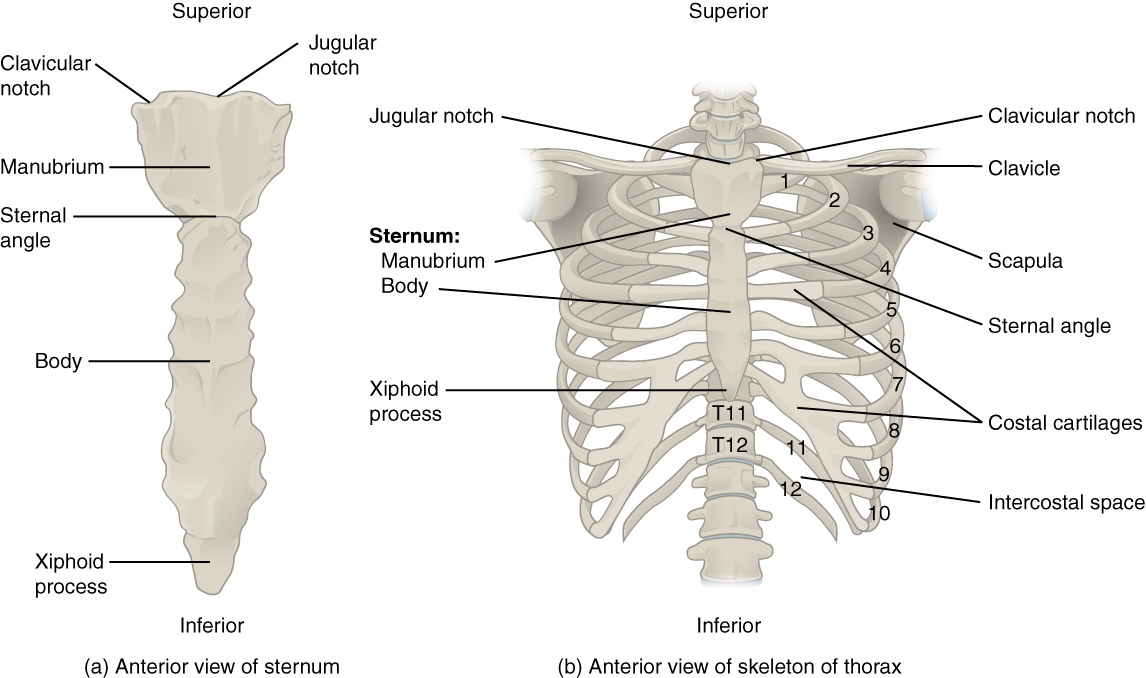
. What is the general shape of the thoracic cage-----21. The manubrium body and xiphoid process. Formed by junction of manubrium and body of sternum.
At the level of lower border of the body of T2 vertebra is where it can be located. The sternum is the elongated bony structure that anchors the anterior thoracic cage. Differentiate between a true rib and a false rib.
Using the terms in the key identify the regions and landmarks of the thoracic cage. No some still remain to be converted to bone. This can be easily felt at the anterior base of the neck between.
Xiphoid process L vertebra. The manubrium is the wider superior portion of the sternum. It consists of three parts.
On manubrium on sternum true ribs kiph-isterfì4-Z--4-- xiphoid process Li vertebra. Is a floating rib a true or a false rib. Are the same skull bones seen in the adult also found in the fetal skull.
The sternum is the elongated bony structure that anchors the anterior thoracic cage. The bony landmarks and articulations allow for the thoracic cage to connect with the pectoral girdle to attach the arm to the central region of the body. The ribs are anchored posteriorly to the 12 thoracic vertebrae T1T12.
The top of the manubrium has a shallow U-shaped border called the jugular suprasternal notch. The manubrium body and xiphoid process. It consists of the 12 pairs of ribs with their costal cartilages and the sternum Figure 638.
Just above the superior border of the manubrium sterni between the proximal medial ends of both clavicles is exactly where the jugular notch is found. Health assessment chapter 18 notes assessment of thorax and lungs position and surface landmarks thoracic cage bony structure with conical shape which is. The manubrium is the wider superior portion of the sternum.
Using the terms in the key identify the regions and landmarks o dentify the regions and landmarks of the thoracic cage. The Thoracic Cage 18. Using the terms in the key identify the regions and landmarks of the thoracic.
The Thoracic Cage 18. Identify the parts of the sternum and define the sternal angle. It consists of three parts.
True ribs Jugular Notch Clavicular Notch Manubrium Sternal Angle Body Sternum Intervertebral Discs Thoracic Vertebrae Intervertebral Foramina Transverse. 140 Review Sheet 9 The Thoracic Cage 18. Jugular notch wa g.
The thoracic cage rib cage forms the thorax chest portion of the body. The clavicle and parts of the thoracic cage provide prominent surface landmarks. Using the terms in the key identify the regions and landmarks of the thoracic cage.
Differentiate between a true rib and a false rib. The thoracic cage protects the heart and lungs. Palpate midway between the spine and the person s side to identify its free tip.
The major bony components of the thorax excluding the vertebral column are the _____ and the _____. The major bony components of the thorax excluding the vertebral column are the and the s 19. The thoracic cage rib cage forms the thorax chest portion of the body.
What is the general shape of the thoracic cage. Using the terms in the key identify the regions and landmarks of the thoracic cage. The Thoracic Cage 18.
Spine il superior angle j. Articulates with costal cartilages of ribs 1-2 and clavicles. Differentiate between a true rib and a false rib.
It consists of the 12 pairs of ribs with their costal cartilages and the sternum Figure 751. Suprasternal notch jugular notch. Using the terms in the key identify the regions and landmarks of the thoracic cage.
The major bony components of the thorax excluding the vertebral column are the and the 19. The ribs are anchored posteriorly to the 12 thoracic vertebrae T1T12. And it lies above the 4 th thoracic.
Is a floating rib a true or a false rib. Using items from the key at the right identify the anatomical landmarks and regions of the scapula. The top of the manubrium has a shallow U-shaped border called the jugular suprasternal notch.
Supraspinous fossa e not on testable list k. Sternal angle sternum j. Directional terms are used to help orient the reader to the thorax.
Costal cartilage 2 d. Using the terms in the key. Using the terms in the key identify the regions and landmarks of the thoracic.
To unlock this lesson you must be a Study. Flat bone with three parts. What is the general shape of the thoracic cage.
Using the terms in the key identify the regions and landmarks of the thoracic cage. Manubrium body and xiphoid process. The bony landmarks of the thoracic wall are as follows.
Body costal cartilage false ribs floating ribs jugular-neteh. Be able to identify the regions and landmarks of the thoracic cage. The major bony components of the thorax excluding the vertebral column are the and the 19.
The cutaneous innervation of the anterior portion of the thoracic wall is from lateral and anterior cutaneous nerves via ventral rami forming a segmental dermatomal pattern.

Landmarks Of The Thoracic Cage Diagram Quizlet
The Thoracic Cage Anatomy And Physiology

The Thoracic Cage Anatomy And Physiology I
0 Response to "Identify the Regions and Landmarks of the Thoracic Cage"
Post a Comment